September 2025
Pest Alert for September 2025
-
- Late-July to October is the time to keep an eye out for pecan weevil. Typically, we expect to see peak pecan weevil emergence between mid-August and mid-September with the threat decreasing after that point. However, with the cooler and wetter year we have had here in Texas, we have seen evidence of irregular patterns of emergence in several pest insects this year. Therefore, it is always important to continue to monitor the orchard for weevil. Weevil can be monitored for by placing circle traps on ‘hot’ trees (trees with a history of weevil infestation) and checking the traps regularly for emergence (see my post from last fall below for more information). Once weevils begin to emerge, it is important to get on a spray schedule of applying carbaryl or pyrethroid at 10–14-day intervals until weevil capture in traps stops. If you are not in a weevil infested area, make sure any and all vehicles and equipment (trucks, tractors, shakers, etc.) that is moved from an infested orchard/area is cleaned and inspected carefully before using it in your orchard. This can help curb the unintentional spread of weevil into uninfested areas.
- Pecan Aphids may continue to be an issue up until dormancy, though populations should start to decrease as the days get shorter heading into fall. Frequent rainfall this year in Texas has suppressed aphid populations in most areas, with few severe outbreaks reported, though some susceptible varieties such as Cheyenne still have supported decent populations. The best way to manage pecan aphids is to frequently monitor for them by examining the foliage, paying extra close attention to the undersides of the leaf where they are more likely to be feeding. Most mature trees can handle large populations of yellow pecan aphid, but it only takes a few black aphids to do considerable damage to a tree. Monitor for aphids throughout the growing season focusing on susceptible varieties such as Cheyenne, Gloria Grande, and Sumner. For thresholds, monitor 10 terminals on 10 randomly selected trees in the orchard. For yellow aphids, treat if 25+ yellow aphids are found per compound leaf. For black aphids, treat if 15% of the terminals have >1 black pecan aphid. Focus on early suppression of smaller populations rather than waiting for a full outbreak to begin treating. Sulfloxaflor (Transform), Flonicamid (Carbine), or Afidopyropen (Sefina) are good products for pecan aphid management, but there are plenty of others as well.
- Several instances of feeding by walnut caterpillar have been reported throughout Texas including Comanche, Guadalupe, Denton, Grimes, and Shackelford counties. While economic infestations are rare, they do occasionally happen in pecan. Fortunately, walnut caterpillars are easy to find in the orchard as they feed in large groups. Small, isolated infestations can be removed and destroyed by hand, while larger more widespread ones may need to be treated with insecticides. If insecticide application is needed, apply insecticides such as methoxyfenozide (Intrepid 2F) or chlorantraniliprole (Vantacor), targeting the caterpillars while they are in their earlier instars (earlier instars have reddish brown markings).
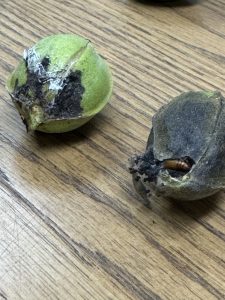
- Hickory shuckworm and late-season pecan nut casebearer (PNC) has also been observed recently as well. While often overlooked, both shuckworm and late-season PNC can cause problems for growers. Caterpillars of both species will tunnel around in the shuck which can cause nut scaring and ‘sticktights’ (a condition that causes the shuck to fail to pop open). Once caterpillar tunneling is observed it is too later to treat for these pests. If heavy damage is observed this year, prepare to treat next year. Pheromone traps deployed for both species can help with monitoring for potential adult flight. Applications of methoxyfenozide (Intrepid 2F) or chlorantraniliprole (Vantacor) can control both species. For shuckworm, apply insecticide at half-shell hardening and a second application 14 days later. In addition, sprays for pecan weevil will also control shuckworm. For PNC, monitor for adult flights and egg lay in the orchard.

March 2025
Time to start monitoring for pecan nut casebearer (PNC)! The recommended deployment date for pheromone traps in South Texas is March 25th. The rest of pecan belt should have traps deployed by EARLY APRIL. This year, the University of Georgia (Apurba Barman) and Texas A&M AgriLife (Kyle Slusher) will have PNC Statewide Monitoring Programs running. These programs will work with county agents and pecan growers to establish sites in the major pecan regions of both states. By trapping in several orchards in major pecan growing counties, these orchards will serve as focal sites for the orchards in that area. When Biofix is reached at one of these sites, information will be sent out to all the growers in the county letting them know it is time to monitor for PNC. Data will also be collected throughout the season to gather more information on the seasonal activities of PNC. Part of this program will involve a collaboration with FMC to supply PNC smart camera traps to these orchards. By testing these camera traps across these two states, this can greatly reduce the labor of having to go out and check traps every day. Check with your county agent to see if your county is currently part of the pilot program. You can also purchase your own traditional (non-camera) PNC traps at Great Lakes IPM Home Page Great Lakes IPM.
Apurba Barman (UGA), Ted Cottrell (USDA-ARS), and Kyle Slusher (TAMU) recently wrote an article for the March issue of Pecan South entitled Pecan Nut Casebearer: Monitoring and Management. Please read this article for the latest PNC management protocol and tools. This article is available in print or on Pecan South Website (March 2025 Archives – Pecan South MagazinePecan South magazine | The pecan industry’s leading publication, published monthly for pecan producers, processors and all others involved or interested in the pecan industry.) (Note: An account is needed to access some online content).
August 2024
Late-season pecan nut casebearer (PNC) damage has been observed in Texas. While 1st generation PNC are often the most destructive, with shifts in climate and weather patterns from year-to-year we will likely see changes in pecan pest biology and seasonal history. Dr. Monte Nesbitt monitors a set of traps out in College Station, TX and noted the following capture trends in his orchard: April 30th (1st generation – earliest capture since he has been reporting), June 15 (2nd generation), July 31st (3rd generation), and August 22nd (4th generation). Given that generations are roughly 45 days apart in emergence, that potentially leaves time for a 5th generation to emerge if conditions are right. While late season PNC are not usually an economic concern (a single nut is often enough to fulfill a larva compared to a whole cluster needed to feed a 1st generation larva), in light crop years where every nut is valuable, monitoring should still be made a priority. Monitoring equipment can be purchase commercially here: https://www.greatlakesipm.com/
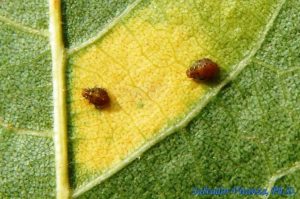

Two black aphid nymphs feeding on a pecan leaf. Note the yellowing (chlorosis) around the feeding site.
July – September is the time to be monitoring for black pecan aphid. Black pecan aphid emerged a little earlier than usual this year, with damaging populations appearing in July. Black aphid feeding elicits leaf chlorosis around the feeding site. This damage is easily detected as large yellow blotches on the leaves. Over time, the chlorotic area will die and turn brown. Black aphid is a more serious pest than the yellow aphids because lower populations cause serious leaf damage and may defoliate a pecan tree. Certain varieties such as ‘Schley,’ ‘Sumner,’ and ‘Gloria Grande,’ are especially vulnerable to black pecan aphid throughout the season, but by late season all cultivars are susceptible.
The management threshold for black aphid is lower than yellow aphid. It is recommended to check all the compound leaves on 10 terminals per tree on at least 10 trees per orchard. Prior to July 1, if 25 percent of terminals have two or more black aphids, treatment should be applied. After July 1, treatment should be applied if 15 percent of terminals have more than one black aphid. In addition to insecticides, gibberellic acid can be used to prevent black aphid feeding and inhibits establishment in the orchard. Gibberellic acid interferes with the feeding biology of the black pecan aphids.
You can read more about pecan aphid management in the September issue of Pecan South.

August – October is the time to monitor for Pecan weevil. Orchards with a history of weevil infestation should start monitoring trees no later then the first week of August. Rainfall, soil moisture, soil type, and irrigation frequency can influence emergence times, with drier areas or areas with clay soil often having later emergence times. Tools for monitoring weevils include:
Placing a white sheet onto the ground and jarring limbs can dislodge adults in the canopy and also knock down nuts that can be examined for larva.
Wire Cone Traps – Built from 1/8 inch-mesh hardware cloth, place traps on soil beneath trees known to have a history of infestation.
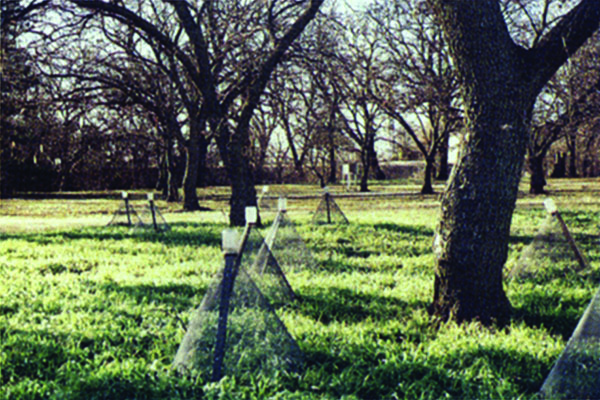
Wire cone traps. Photo Credit: Phillip G. Mulder, OSU
Pyramid or Tedders Traps – Pyramid traps made from two triangular pieces of 1/2 inch hardboard interlocked to form a 4 foot tall trap. Fitted with a container at the top for capturing weevils. These should be placed under trees with a history of infestation. Painting the trunk of adjacent trees white can increase trap captures. Commercial models can be purchased at: https://www.greatlakesipm.com/monitoring/traps/great-lakes-ipm/glgl500306-pecan-weevil-tedders-pyramid-trap-6cs
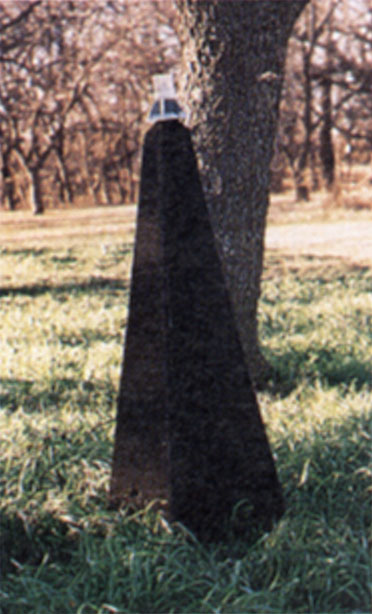
Pyramid or Tedder’s Trap. Photo Credit: Phillip G. Mulder, OSU
Circle/Trunk Trap – Wire mesh traps that can be secured to trees to capture adult weevils as they climb up the trunk towards the canopy. These can be beneficial to growers as they can be left up year round and don’t interfere with mowing or grazing cattle. Commercial models can be purchased here: https://www.greatlakesipm.com/monitoring/traps/great-lakes-ipm/glgl401006-circle-trunk-trap-large-6cs.
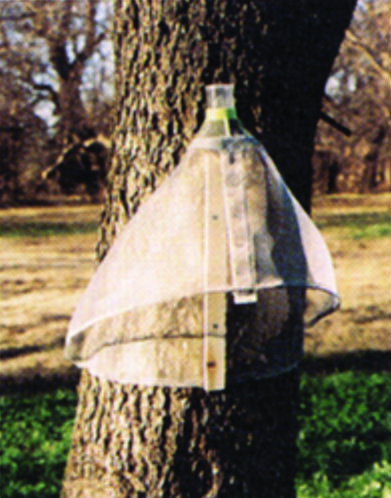
A Circle Trap. Photo Credit: Phillip G. Mulder, OSU
Traps should be attached to trees with a history of infestation. If there is not a history of infestation known, traps should be placed on as many trees as possible. In studies comparing the three traps, circle traps were the least expensive, followed by the pyramid and wire cone emergence traps. Circle traps also captured more than three times as many pecan weevils than either of the other trap types.
For more information on traps and trap construction, check here: https://extension.okstate.edu/fact-sheets/monitoring-adult-weevil-populations-in-pecan-and-fruit-trees-in-oklahoma.html
Regardless of trap used, it should be noted that the number of weevils captured should be used as a guideline, and does not necessarily reflect the actual population of weevils in an area.
August 2013
Pecan weevil management decision-making is upon us. Note that many pecan growing areas are facing drought conditions. This may result in drought-delayed emergence well beyond the normal emergence time for this pest, particularly in orchards and groves with clay soils. Read more.
June 2013


Bill Ree reports walnut caterpillar activity on pecan. Pecan producers or those with urban pecan trees should be watching for this insect. The real damage will occur when the larvae reach the 5th (last) instar. This is the stage when the larvae is black with long white hairs (pictured). These insects can defoliate a tree in 3 – 4 days.
Infestation signs:
- colonies on branch terminals
- a mass of cast skins on the main trunk or scaffold limbs
- a lot of frass on sidewalks or driveways
- branch terminals with missing foliage but leaf rachis still in tact
Control options:
- For homeowners – Bt-based insecticides and products with spinosad (ex: Green Light Lawn and Garden with Spinosad)
- For commercial producers – Intrepid, Confirm, Belt, Delegate are preferred.
- For organic producers – Entrust, certified Bt insecticides, Azera and Neemix
August 2012
July 2012
Walnut Sphinx
An outbreak of the walnut sphinx, Amorpha juglandis, was in early July 2012 infesting and defoliating about 100 acres of primarily native orchards between Highway 36 and 1702, south of Gustine, Texas.
Read more and see photos >>>
May 2012
Walnut Caterpillar Alert
Producers should be on the lookout for walnut caterpillars starting to lay eggs in the next generation in about 3 weeks and then expect one more generations to occur about 6 weeks after that. Walnut caterpillars have been found as 4th instar larvae and are occurring earlier than usual in Victoria (Victoria County) and Cuero (DeWitt County), Texas.

August 2011
Pecan Weevil Alert
Pecan weevil management decision-making is upon us. Note that many pecan growing areas are facing drought conditions. This may result in drought-delayed emergence well beyond the normal emergence time for this pest, particularly in orchards and groves with clay soils.
Read more >>>
June 2011

Brown Marmorated Stinkbug ALERT
A regional pest alert has been issued for the brown marmorated stinkbug. Please see this publication for important information.
August 2010
Pecan Weevil Alert
Pecan weevil management decision-making is already upon us. Note that many pecan growing areas are facing dry conditions, and this may result in drought-delayed emergence well beyond the normal emergence time for this pest, particularly in orchards and groves with clay soils.
Read more >>>
Thousand cankers disease of black walnut reported in Tennessee on July 26, 2010. See companion materials listed below for details. Based on limited research, pecan is not known to be at risk from this disease. Scientists at Colorado State University will provide expert assistance if this disease is suspected present and local scientists should also be informed.
- Thousand Cankers Disease, USDA Forest Service Pest Alert
- Economic Loss Associated with the Introduction of Thousand Cankers Disease of Black Walnut to Kansas, Kansas Forest Service, Kansas State University
- July 26 alert, Walnut twig beetle and Geosmithia sp. nov. found in Tennessee, Department of Bioagricultural Sciences and Pest Management, Colorado State University
- Colorado State University website on Thousand Cankers Disease
July 2010
Leaf Nutrition Month
July is the time to collect and submit leaf samples for analysis to determine the amount of essential minerals your pecan trees are absorbing from the soil or from foliar treatments. Nitrogen, potassium, zinc and other nutrient deficiencies can be identified from leaf samples.
We have developed an information packet with instructions and locations for submitting leaf samples:
Instructions for Pecan Leaf Sample Collection for Nutritional Analysis [PDF]
June 2010
Walnut Caterpillar Alert
We are observing walnut caterpillar late instar larvae on pecan in Victoria and Cuero, Texas. Hatch of the next generation at those locations is anticipated to occur about June 25th.
The last couple of years, infestations were observed in Cuero along the Guadalupe River, but so far these have not expanded into an epidemic that defoliates wide expanses of pecans and hickories. Past experience shows walnut caterpillar is capable of widespread defoliation over entire river systems and vigilance is needed to detect them and treat them, if needed, before defoliation occurs.
April 2010
The Pecan IPM PIPE Library is now open!
The Pecan IPM Library offers a wide range of research-based information that can help our constituents make informed decisions about integrated pest management in their pecan operations. Formats include Extension publications, journal articles, newsletters, slide and video presentations and proceedings articles.
January 2010
The Pecan IPM Pesticide search engine is available.
Search the National Agriculture Library’s Thesaurus and Glossary from our site. See IPM Resources at the bottom of this page. The Thesaurus and Glossary are online vocabulary tools of agricultural terms in English and Spanish.